
UNIVERSITY
- About Us
- History
- Kadir Has
- Kadir Has Foundation
- Our Philosophy
- Vision, Mission, and Values
- Strategic Plan
- Quality Assurance
- 100th Anniversary of the Republic
- Management
- Board of Trustees
- Rectorship
- University Senate
- Executive Board
- Academic Council
- Academic Units
- Administrative Offices
- Organization Chart
- Regulations and Guidelines
- Principles and Policies
- Academic Principles
- Our Policies
- Corporate Social Responsibility Approach
- Policy Against Harassment and Discrimination
- Inclusive Gender Equality Policy (2025-2027)
- Ethical Guidance on the Use of Generative Artificial Intelligence (GENERATIVE AI) Tools
- Institutional Development
- Social Impact @ KHAS
- Institutional Internal Audit Report
- UNGC Report
EDUCATION
- Education at KHAS
- Core Program
- Project Based Education
- Double Major-Minor
- LISAR@KHAS Program
- Library
- KHAS Academies
- Academic Calendar
- Registration and Application
- Directorate of Student Affairs
- Graduate Applications
- Special Student
- Scholarships and Fees
- Registration Procedures
- Frequently Asked Questions
RESEARCH
- R&D Support Units
- R&D Resources Directorate
- Project Management Office
- Project Development Office
- KHAS Silivri Teknopark
- Research Facilities
- Research Centers
- Research Groups
- Laboratories
- UNESCO Chair
- Research Outputs and World Rankings
- Scientific Projects
- Scientific Publications
- Publication Archive
- Institutional Research
- Our World Rankings
LIFE IN KHAS
- Support Units
- Dean of Students
- Student Council
- KHAS Peer Program
- Career Office
- Accessible KHAS Commission
- Housing, Nutrition and Social Areas
- Accommodation
- Food & Beverage
- Social Areas
- Campus Life Office
- Sport, Culture and Arts
- Student Societies
- Student Clubs Union and Executive Board
- Sports Tournaments and Teams
- Culture-Art Events
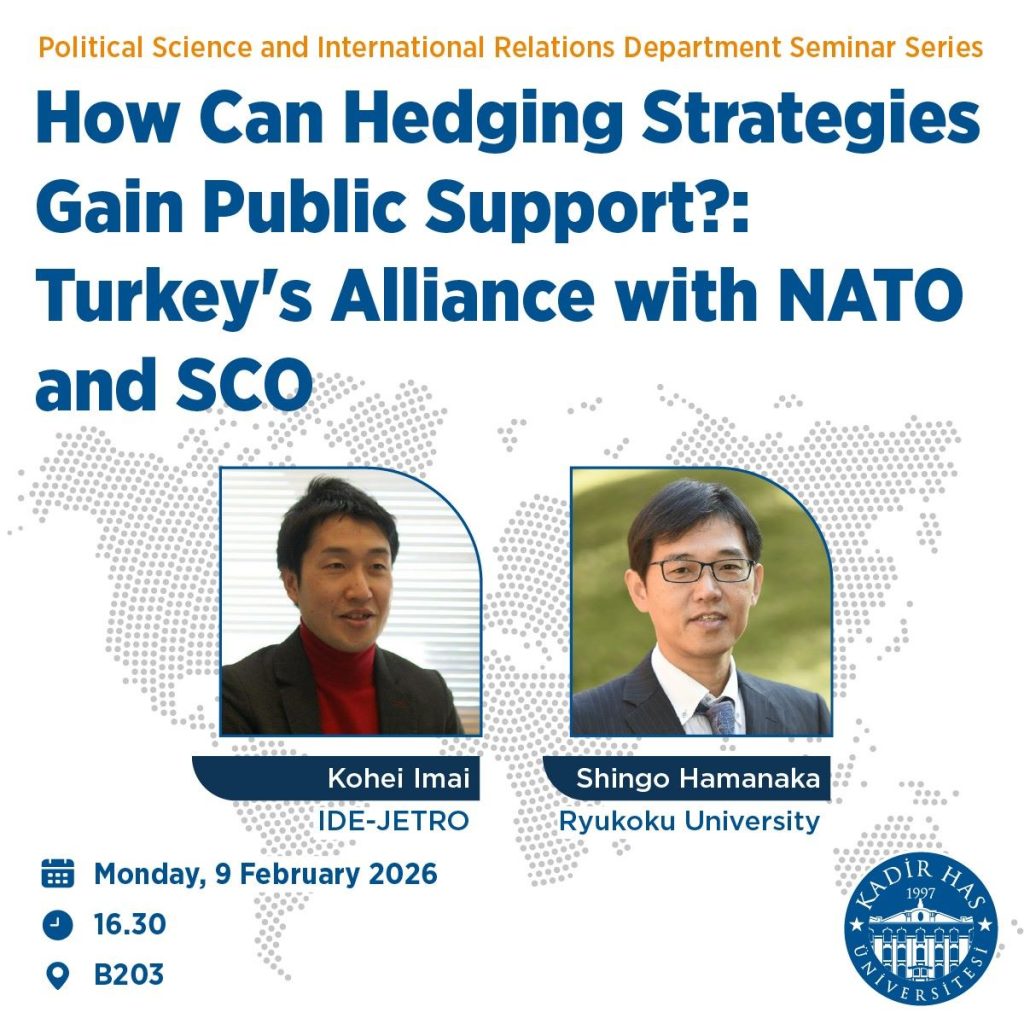
How Can Hedging Strategies Gain Public Support?: Turkey’s Alliance with NATO and SCO
Strategic hedging in international relations refers to the behavior of junior partner states that seek to maintain good relations with other neighboring superpowers while maintaining ties with their allied superpowers. Hedging is a relatively new concept in alliance theory that emerged in the mid-2000s. As a result, there is still a lack of clear criteria for which states qualify as hedging and case studies examining the conditions under which publics support hedging strategies. Regarding the latter, modern democracies cannot ignore public opinion in important policy areas, and alliance changes are constrained by public opinion or at least require ex post facto approval. This study focuses on Turkey, a NATO member state that is also known as a swing state due to its geographical location and frequent opportunities to adopt omnidirectional diplomacy, and a dialogue partner of the Shanghai Cooperation Organization (SCO). Using an experimental public opinion survey, we explore the conditions under which public support a hedging strategy that approaches the SCO. This case study of hedging strategies between security organizations, rather than between major powers, is unprecedented, providing new insights into hedging strategies. There are three main hypotheses that lead to support for a hedging strategy: (1) leader cues, (2) information cues from senior partners, and (3) political change within the system. The leader cues hypothesis posits that when people are informed that President Erdogan wants to join the SCO, they will support deepening ties with the SCO. Next, the rhetoric of President Trump, a senior partner in NATO, may act as information cues that influence people’s attitudes toward the SCO. If Trump suggests that NATO member states will increase their burden, people may dislike burden sharing and prefer a hedging strategy that involves moving closer to the SCO. Furthermore, if Trump takes a tough stance toward the SCO, people may prefer a strategy that distances them from the SCO. Finally, political change within the system may lead people to become more conservative and prefer strengthening existing alliances.