
English Preparatory Program (EPP)
KHAS SFL Teaching and Learning Philosophy
Our teaching and learning philosophy is based on the values and principles below. We aim to foster an inclusive and reflective academic environment where students, instructors, and all members of the SFL community learn from one another and embrace new ideas and practices. Our approach supports both personal growth and academic achievement, preparing learners for success in their university studies and beyond.
Inclusive and Equitable Learning Environment
We aim to create a positive, respectful classroom atmosphere where every student feels valued and supported. As part of the SFL community, you will be encouraged to share your ideas, respect different perspectives, and ask for help when needed.
Our goal is to provide you with equal opportunities to succeed and to help you feel confident as you learn.
Learner-Centered Approach
In our program, you are at the center of the learning process. You will explore course materials actively, work together with your classmates, and take increasing responsibility for your progress.
Teachers guide and support you as you become an independent learner who can ask questions, reflect on learning, and apply new skills in academic and real-world situations.
Focus on Academic English Skills
The program supports the development of your academic English by using materials that combine reading, writing, listening, and speaking skills. These materials are built around global and academic content and are organized around themes. This integrated, theme-based approach helps you build the language and study skills you need for success in your faculty courses.
Text-based Academic Writing Approach
In your lessons, you will learn academic writing by reading and exploring a variety of academic texts. After understanding the meaning, we focus on how ideas are organized and how language works in that context.
By analyzing these features, you will build awareness of useful language structures and learn to paraphrase, summarize, analyze, and synthesize information in your own words. This approach helps you develop strong academic skills and prepares you for research-based writing tasks at your faculty.
Global Competence and Life Skills
Our program is designed to foster global awareness and the development of transferable life skills such as independent thinking, adaptability, collaboration, and problem-solving. In the SFL classroom, we encourage you to express your ideas clearly, engage constructively with diverse perspectives, and ask meaningful questions.
2025-2026 EDUCATION PROGRAM
The KHAS English Preparation Program is semester-based.
- Fall Semester: 16 Weeks
- Spring Semester: 16 Weeks
- Summer School (6-8 weeks)
Summer School
Summer School is an intensive program designed to help students who have not reached the target language proficiency level during the Fall and Spring semesters to attain that level and complete the English Preparatory Program within the same academic year. This program is designed to support students in addressing their language development deficiencies and accelerating their progress. Therefore, the number of weekly class hours is higher compared to the other semesters.
Students who start the program at the Track Intro or Track 1 levels in the Fall semester generally need to attend Summer School in order to complete the program within one academic year.
To be eligible for Summer School enrolment, students must meet the attendance and GPA requirements announced at the beginning of the academic year. Summer School is fee-based, and the relevant fee information is announced at the end of the Spring semester.
Track Level Descriptors
The KHAS English Preparation Program consists of 5 different levels of courses.
- TRACK INTRO/FOUNDATIONAL ENGLISH
- TRACK 1/ INDEPENDENT ENGLISH
- TRACK 2/ EXPANDING ENGLISH
- TRACK 3/ COMPETENT ENGLISH
- TRACK 4/ ADVANCED ENGLISH
Track Intro: Foundational English (A2 to A2+)
Track Intro aims to bring learners with limited English knowledge to a level where they can manage basic communication in everyday contexts. Through integrated work on all four skills, a focus on building core vocabulary and grammar, and guided online practice, this track builds the foundation for the development of further essential language skills.
Students who begin the program at the Track Intro level typically continue their studies across three semesters (Fall, Spring, and Summer School) to complete the program successfully and build a strong language foundation.
Track 1: Independent English (A2+ to B1)
Track 1 aims to enable learners to communicate with growing independence in familiar personal, academic, and professional situations. Using theme-based content and a balance of skills practice in reading, writing, listening, and speaking, supported by online materials, this track consolidates essential language structures and expands learners’ ability to express ideas clearly.
Students who begin the program at Track 1 may need to study for three periods, including Summer School, in order to reach the level of language proficiency required to successfully complete the program.
Track 2: Expanding English (B1 to B1+)
Track 2 focuses on extending learners’ competence so they can interact with more confidence and deal with a wider range of academic and real-life topics. Through exposure to more in-depth academic themes and supported online study, learners begin to handle more complex information and participate in a broader variety of language tasks.
Track 3: Competent English (B1+ to B2)
Track 3 develops learners’ ability to work with academic and abstract content, encouraging greater independence in understanding and expressing ideas. Through analysis of academic materials and online practice, learners enhance their competence across all four skills and begin to communicate with increased fluency and accuracy.
Track 4: Advanced English (B2 to B2+)
Track 4 aims to help students work effectively in academic contexts by engaging with content from their own or related fields. At this level, authentic academic texts and online support are used to develop advanced academic skills. Through this process, students gain the language competence and confidence required for their first-year faculty courses.
SFL EPP Learning Outcomes and Track Progression Charts
The English Preparatory Program is organized in progressive stages to help students build their language skills step by step. All courses and assessments are aligned with the Common European Framework of Reference for Languages, an international framework that defines what learners can understand and produce at different proficiency levels.
Each stage of the program has specific learning outcomes that explain what students will be able to do in English by the end of that stage. These outcomes include listening, speaking, reading and writing as well as the academic skills and strategies needed for university study. Students progress through the tracks according to their English level and, once they achieve the required proficiency, become eligible to complete the program.
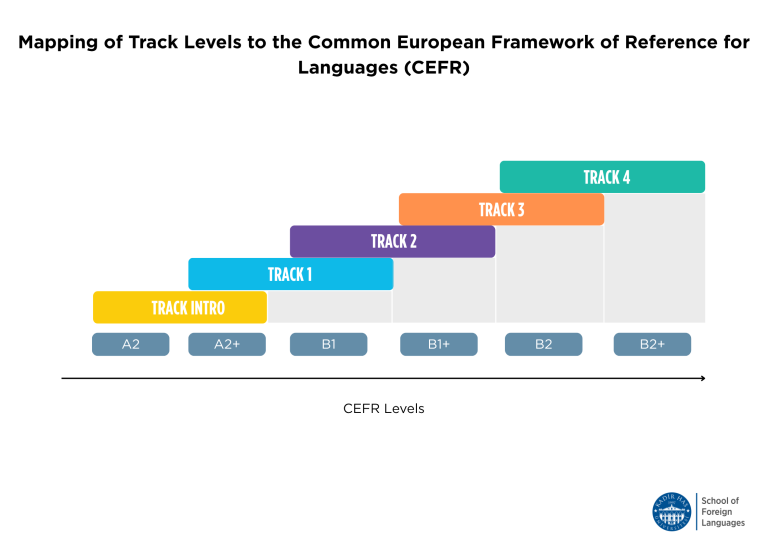
Figure 1: Mapping of Track Levels to the Common European Framework of Reference for Languages (CEFR)
Track Intro: Foundational English (A2 to A2+)
By the end of Track Intro, students will be able to:
- Understand simple, clear spoken language related to familiar topics (e.g., personal information and daily routines) when delivered slowly and clearly.
- Identify main ideas and specific details in short, simple texts containing high-frequency vocabulary.
- Give basic descriptions or short presentations on familiar topics, using simple phrases and sentences, and link ideas with basic connectors.
- Participate in simple, routine exchanges of information on familiar subjects, such as greetings and personal preferences.
- Write short paragraphs using basic sentence structures and simple connectors to describe people, places, and routines.
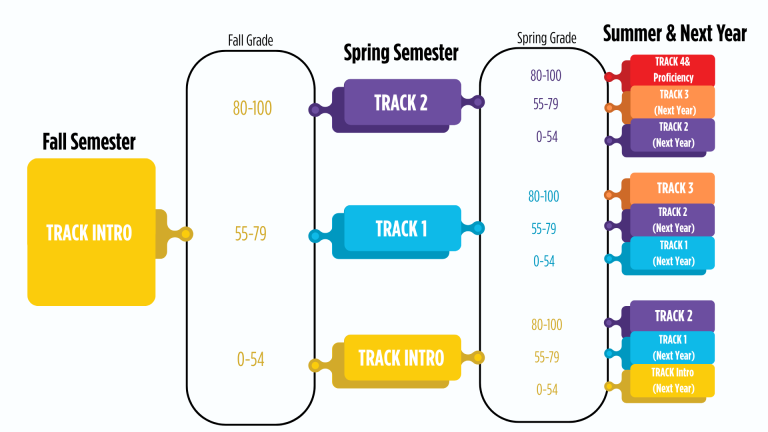
Figure 2: Track Intro Progression
Track 1: Independent English (A2+ to B1)
By the end of Track 1, students will be able to:
- Understand main ideas and key details in clear, standard speech on familiar topics encountered in daily life or academic settings.
- Read straightforward factual texts on familiar subjects, with satisfactory understanding of content and context.
- Give structured descriptions or explanations on familiar topics, presenting ideas in a linear sequence with simple elaboration.
- Take part in simple conversations on familiar topics, asking and answering questions, and exchanging ideas with some fluency.
- Write connected paragraphs on familiar topics, using a variety of basic connectors and structures to express and support ideas.
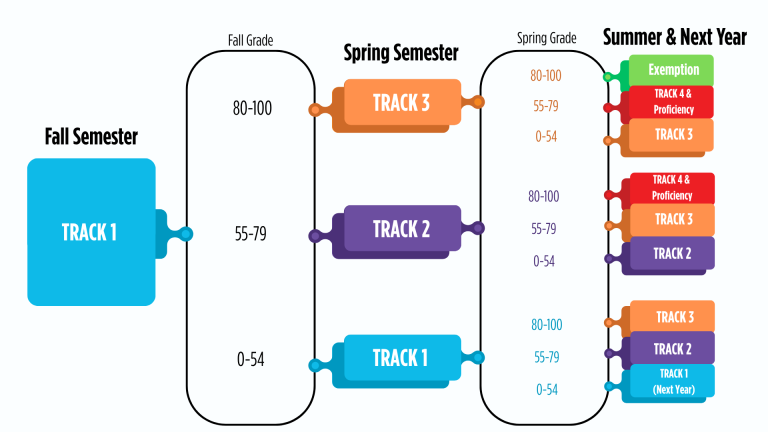
Figure 3: Track 1 Progression
Track 2: Expanding English (B1 to B1+)
By the end of Track 2, students will be able to:
- Understand main points and details in clear, standard speech on familiar and academic topics, including complex information when it is clearly structured.
- Read and understand both factual and abstract texts, adapting reading style and speed as needed to understand key ideas and details.
- Give a presentation on a familiar topic within their field, conveying ideas with relative ease.
- Interact with a higher level of confidence, sustaining conversations on a variety of topics, expressing opinions, and engaging in simple discussions.
- Write clear, structured paragraphs on a range of topics, linking ideas and supporting claims with relevant examples and details.
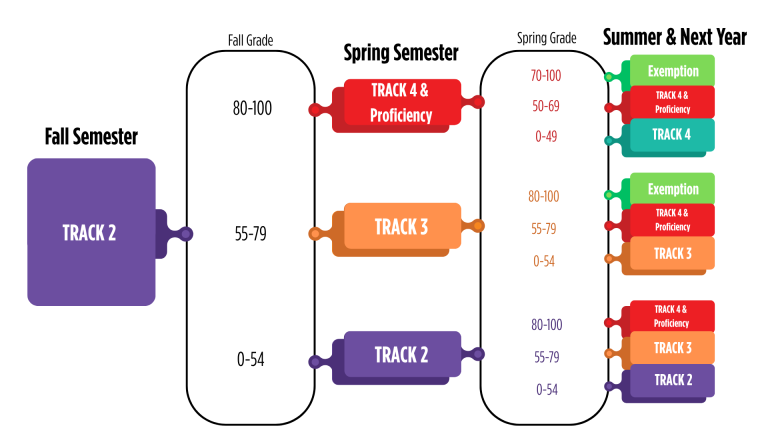
Figure 4: Track 2 Progression
Track 3: Competent English (B1+ to B2)
By the end of Track 3, students will be able to:
- Understand complex spoken discourse on both familiar and abstract topics and follow extended arguments, identifying key ideas and details even in academic discussions.
- Read with a high degree of independence, a wide range of texts related to academic and professional topics, synthesizing information from different sources and adapting reading strategies accordingly.
- Present detailed descriptions, explanations, and presentations on both concrete and abstract topics, using some complex structures and linking ideas effectively.
- Engage in fluent, spontaneous interactions on a wide range of topics, expressing and justifying opinions clearly.
- Write detailed, cohesive paragraphs related to their field of study, synthesizing and evaluating information from multiple sources, with appropriate structure and clarity.
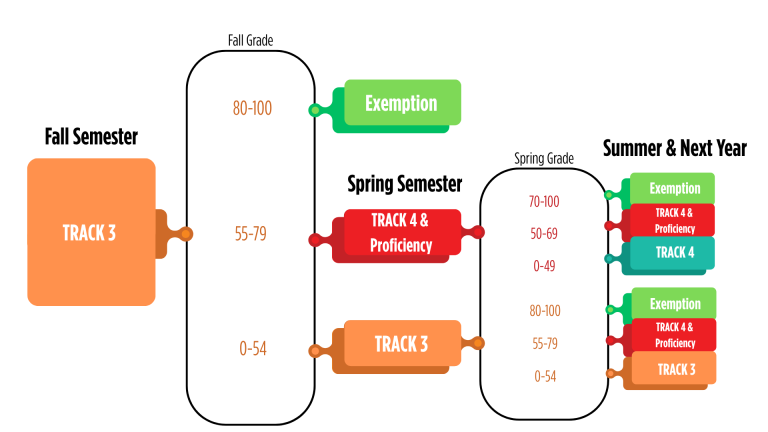
Figure 5: Track 3 Progression
Track 4: Advanced English (B2 to B2+)
By the end of Track 4, students will be able to:
- Understand essentials and details of complex spoken discourse on familiar, unfamiliar and abstract topics related to academic or professional life.
- Read and comprehend in detail a wide range of lengthy, complex texts within their own field and related fields of study interpreting, comparing and synthesizing information from different sources and adapting reading strategies accordingly.
- Present clear, systematically developed arguments, providing detailed explanations and supporting points with relevant evidence in both academic and everyday contexts.
- Communicate spontaneously, express ideas and opinions with precision, remarkable fluency adopting a level of formality appropriate to the circumstances.
- Write detailed, cohesive paragraphs related to their field of study, synthesizing and evaluating information from multiple sources, with appropriate structure and clarity.
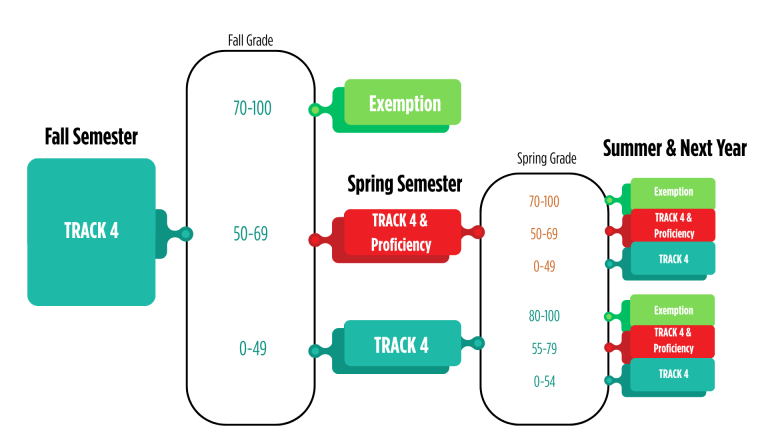
Figure 6: Track 4 Progression
KHAS SFL Assessment System
Coursework Assessment
Assessment consists of tasks and exams designed to measure your progress in reading, writing, listening, and speaking, as well as your grammar and vocabulary. These components are similar across all tracks. Throughout the semester, you receive written and/or oral feedback to help you understand what you do well and where you need to improve before exams.
Writing Tasks
You will complete in-class writing tasks that include two drafts. After the first draft, you will receive detailed feedback on language, content, and the organization of your ideas. You will then revise and submit a final draft, improving your writing in terms of clarity, structure, and language use.
Speaking Tasks
You will complete both individual and pair/group speaking tasks. Individual tasks involve preparing and presenting a topic to the class. Pair and group discussions focus on topics covered during the semester and aim to develop your communication and collaboration skills.
Homework Assignments
Homework may include grammar and vocabulary exercises, reading or listening practice, or written responses. These assignments reinforce classroom learning and prepare you for assessments. You are expected to complete them outside of class to support ongoing learning and to develop your autonomy. It is your responsibility to meet deadlines and submit your work on time.
Examinations
Midterm and Final Exams
These exams assess your progress in reading, writing, listening, and speaking as well as language development. They are based on the content you have studied up to the time of each exam.
Reading Exams
You are assessed on your ability to understand main ideas, details, opinions, and how information is organized in academic texts. You will answer comprehension questions based on what you have read.
Listening Exams
You are assessed on your ability to identify main ideas, specific details, and understand spoken input in academic and everyday contexts. At lower levels, you will listen and answer while listening. At higher levels, you will additionally listen to short academic lectures, take notes, and answer questions based on your notes.
Writing Exams
Writing exams test your ability to produce a clear, well-organized text based on a prompt and a source. You are assessed on how well you respond to the task, how clearly and logically you organize your ideas using paragraphs and linking words, and how accurately and appropriately you use grammar and vocabulary.
Speaking Exams
Speaking exams assess your fluency, clarity, interaction, and appropriate use of language. The exam is administered in pairs or groups where you are asked to discuss familiar academic topics covered throughout the course.
Language Exams
Language exams test your understanding and use of vocabulary and grammar. They are given as progress tests and as part of the Midterm and Final Exams. Grammar is assessed mainly at lower levels, while vocabulary is tested at all levels, the assessment of grammar and vocabulary is also integrated into reading, listening, speaking and writing tasks and exams.
Academic Integration Module (Tracks 3 & 4 only)
In the final six weeks of the semester, students in Tracks 3 and 4 participate in the Academic Integration Module. In this module, you will attend weekly sessions taught by faculty from your future departments. These sessions introduce key vocabulary and academic concepts from your field of study. Assessment in this module follows the criteria set by each faculty and focuses on your understanding of key terms and your ability to use them in academic contexts.