The table shows the gender distribution of senior-year students in 2024. Out of a total of 827 students, 473 are female (57.2%) and 354 are male (42.8%). This indicates a higher representation of female students in the final year.

KADIR HAS UNIVERSITY GRADUATE / ALUMNI STATISTICS WITH GENDER DIVISIONS
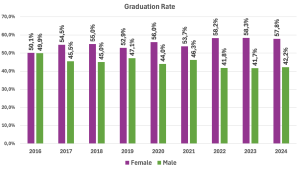
From 2016 to 2024, Kadir Has University has demonstrated a steady and meaningful advancement in gender balance among its graduates. The data clearly shows that female representation has grown not only in proportion but also in absolute numbers, reinforcing the university’s institutional commitment to gender equality in higher education.
In 2016, the distribution of graduates was almost perfectly balanced, with 306 female and 305 male graduates. This early parity laid the groundwork for sustained growth in female representation in the years that followed. By 2017, the number of female graduates had increased to 404 compared to 337 male graduates, beginning a consistent upward trend that continued into 2018, when female graduates numbered 464 against 380 male graduates. This progression marked the start of a positive and lasting shift in favor of women’s participation and achievement in higher education at KHAS.
The turning point came in 2019, when female graduates constituted 52.87% of all graduates, surpassing men for the first time. From that year onward, women have consistently represented more than half of the total graduate population, illustrating that the progress made is structural rather than temporary. Despite occasional fluctuations in total graduate numbers, the proportion of female graduates has remained stable and strong: 56.01% in 2020, 53.75% in 2021, and 58.25% in 2022. The trend reached its highest point in 2023, when women accounted for 58.34% of all graduates (500 female vs. 357 male students).
In 2024, this strong pattern continued, with the highest-ever number of female graduates recorded—539 women compared to 393 men. While the percentage (57.83%) represents a slight decline from the previous year, the total number of women graduating has increased, proving that gender equality at KHAS is not only about proportional representation but also about expanding access and opportunity on a larger scale. This demonstrates that equity and growth can coexist—female participation has risen even as the overall graduate population expanded.
The sustained rise of female graduates over nearly a decade reflects the effectiveness of KHAS’s institutional strategies and policies. Initiatives such as targeted scholarships, mentoring programs, inclusive academic support systems, and gender-sensitive policies have all contributed to these results. The university’s consistent alignment with Sustainable Development Goal 5 (Gender Equality) has provided a strategic framework for empowering women across all fields of study.
Between 2016 and 2024, KHAS produced 3,867 female graduates compared to 3,116 male graduates, making women approximately 55% of all graduates over nine years. Importantly, since 2019, the female majority has stabilized at an average of 56–57%, highlighting that this progress is sustainable and institutionally embedded.
Looking ahead, the key challenge will be to translate academic equity into professional equity—ensuring that women not only graduate in higher numbers but also advance into leadership and research positions. Continued tracking of career outcomes, targeted professional development programs, and alumni networking initiatives will be essential in carrying this success beyond graduation.
In conclusion, the gender statistics from 2016 to 2024 clearly illustrate that Kadir Has University has moved beyond mere policy statements to achieve measurable, sustained, and scalable gender equality outcomes. The record numbers in 2024 confirm that KHAS’s approach—grounded in inclusion, support, and opportunity—has created a lasting model of progress for gender equity in higher education.
You can find below the gender statistics of our graduates / alumni.
| Year | Female Students | Male Students |
| 2016 | 306 | 305 |
| 2017 | 404 | 337 |
| 2018 | 464 | 380 |
| 2019 | 387 | 345 |
| 2020 | 452 | 355 |
| 2021 | 416 | 358 |
| 2022 | 399 | 286 |
| 2023 | 500 | 357 |
| 2024 | 539 | 393 |
| Male | Female | Total |
| 354 | 473 | 827 |
Number of Graduates / Alumnis by Gender (Including Double Major Students) Annual Faculty Comparisions – 2024
Faculty | Male Students | Female Students | Grand Total |
Faculty of Law | 52 | 84 | 136 |
Faculty of Economics, Administrative and Social Sciences | 98 | 112 | 210 |
Faculty of Communication | 37 | 65 | 102 |
School of Graduate Studies | 52 | 92 | 144 |
Faculty of Engineering and Natural Sciences | 133 | 104 | 237 |
Faculty of Art and Design | 21 | 82 | 103 |
Grand Total | 393 | 539 | 932 |