Responsible production and consumption practices are embedded in both campus operations and the academic curriculum. KHAS implements strict waste management protocols aligned with national regulations, separating paper, plastic, glass, metal, medical, and electronic waste. Recyclable materials are collected by licensed companies, and leftover food supports street animals. Courses and workshops on sustainability, circular economy, and social innovation raise awareness among students, while operational measures—such as optimizing catering services to prevent overproduction—reinforce the University’s commitment to responsible resource use.
12.1. Events
- KHAS High School Law Academy VIII – Current Developments in Law
- Speaker: Res. Asst. Alican Çalışkan
- Topic: Damages Arising from Defective Products
- Date: 22 May 2024
- Conference Presentation: Economic Uncertainty and Climate Change Exposure: The Impact of the Paris Agreement and Corporate Ownership
- Presenter: Seda Erdoğan
- Conference: Eurasia Business and Economics Society (EBES) Conference
- Date & Location: 18–20 April 2024, Berlin, Germany
- Conference Presentation: Women Are More Responsible in Environmental, Social and Governance Issues, Yet When?
- Presenter: Seda Erdoğan
- Conference: European Financial Management Association (EFMA) Conference
- Date & Location: 1 July 2023, Cardiff, Wales
- Faculty of Art and Design | Unit/Center: Beykoz Kundura
- Activity Type: Panel
- Title: Local Content, New Form (Yerli İçerik, Yeni Biçim)
- Date: 16 December 2023
- Summary: Moderated and curated by Özlem Hemiş and Ayşe Draz, the panel explored Turkey’s theater landscape and the cultural policies shaping it. Prof. Dr. Dikmen Gürün presented perspectives on the formation of Turkey’s theater scene and the cultural policies influencing it, followed by discussions with artists whose works were supported by Beykoz Kundura’s educational and production programs.[1][2]
- Faculty of Art and Design | Department of Industrial Design
- Course: IND382 – Social Innovation
- Activity: Seminar & Workshop Collaboration
- Title: Design for Child’s Rights and Sustainable Play
- Semester: May 2024
12.2. Projects
- Center for Liability Law Practice and Research.[3]
- Green Library Project: Implemented initiatives in waste management, water conservation, energy efficiency, and ensured free access to clean water through fountains and filtered dispensers.
- Book Donation Campaigns (2023): 9,477 volumes donated to schools, penal institutions, universities, and municipalities; “gift-a-book” drives were organized with the participation of university members.
- Book Donation Campaigns (2024): 8,609 volumes donated to ten beneficiary institutions, continuing the “gift-a-book” initiative.
- TÜBİTAK 1005 Industrial Symbiosis Project (Adana OIZ) – Volkan Ş. Ediger
- “A Life Cycle Analysis-Supported Industrial Symbiosis Model” – Volkan Ş. Ediger
- Faculty of Art and Design | Financial Manager, Turkey Management Committee Member | Erek, A.
- CA 18204 – “Dynamics of Placemaking and Digitization in Europe’s Cities,” EU COST Project (2019–2024).
- Faculty of Art and Design | Industrial Design Department | Workshop Collaboration within IND303 Contemporary Conceptual Approaches in Design
- Workshop: Advanced Upcycling with Pınar Akkurt
- Sustainability Practices in Education:
- Educational materials were digitized, reducing the need for printing and encouraging sustainable resource use.
- Paper consumption quotas were implemented for academic and administrative staff to prevent waste.
- These practices contribute to energy and resource savings, supporting the university’s environmental sustainability goals. (School of Foreign Languages – YDYO)
- OHS / Sustainability Projects (ISG Projects):
Kadir Has University has initiated a zero-waste management process by procuring the necessary equipment in line with the Zero Waste Regulation. Packaging waste is separated using triple-set bins. Paper-cardboard, plastic, metal, and glass waste are collected separately. Special waste, including used batteries, fluorescent lamps, and hazardous laboratory waste, is also collected and stored separately to ensure safe disposal.
- Waste Management and Zero-Waste Certification
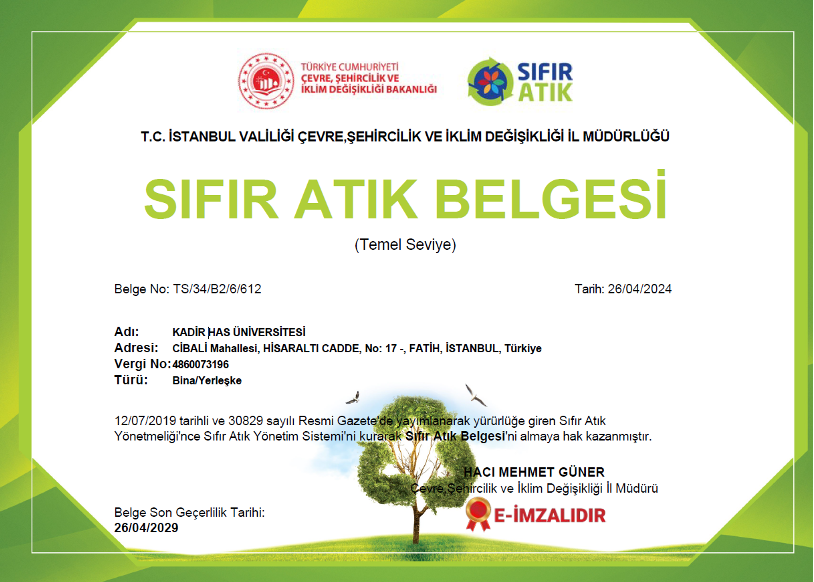
Kadir Has University has established a zero-waste system to reduce the amount of waste released into nature and to increase recycling rates. In 2024, basic-level Zero Waste Certificates were obtained for each campus building from the Provincial Directorate of Environment, Urbanization and Climate Change.
[1] https://beykozkundura.com/kultur-sanat/sahne
[2] https://www.youtube.com/watch?v=HYeMhw5qdks
[3] https://www.khas.edu.tr/law-arastirma-merkezleri/
- Recyclable Waste Management
The university systematically separates paper, glass, plastic, metal, and hazardous waste and monitors their recycling performance annually:
- 2023 Waste Recycling Distribution:
- Paper waste recycling: 15%
- Other recyclable waste (glass-plastic-metal-mixed): 66%
- Recycled hazardous waste: 19%
- 2024 Waste Recycling Distribution:
- Paper waste recycling: 64%
- Other recyclable waste (glass-plastic-metal-mixed): 26%
- Recycled hazardous waste: 10%
12.3. Publications
- A multi-criteria decision-making method for thermal insulation material selection in nZEB level questioned affordable multifamily housings
Author(s): Yılmaz, B., Acun Özgünler, S., and Yılmaz, Y.
Year: 2024 - The impact of perceived corporate social responsibility on consumer happiness and brand admiration
Author(s): Tosun, P. and Tavşan, N.
Year: 2024 - Assessing and selecting sustainable refrigerated road vehicles in food logistics using a novel multi-criteria group decision-making model
Author(s): Faruk Görçün, Ö., Tirkolaee, E., Kucukonder, H., and Garg, C.
Year: 2024 - Barriers to gender-based pro-environmental travel behavior
Author(s): Chalermchaikit, V. and Kozak, M.
Year: 2024 - Handbook of Tourism and Consumer Behavior
Author(s): Zheng, D., Kozak, M., and Wen, J.
Year: 2024 - Anatolia–unveiling its multidisciplinary landscape and future orientations
Author(s): Kaurav, R., Singhania, S., and Kozak, M.
Year: 2024 - Interdependency of Passive Design Strategies for Energy-Efficient Building Envelope
Author(s): Reffat, R., Cetin, M., and Abdou, A.
Year: 2024 - 3D Printer Selection for the Sustainable Manufacturing Industry Using an Integrated Decision-Making Model Based on Dombi Operators in the Fermatean Fuzzy Environment
Author(s): Görçün, Ö., Hashemkhani Zolfani, S., Kucukonder, H., Antucheviciene, J., and Pavlovskis, M.
Year: 2024 - Tourist personality, value co-creation, and emotional well-being
Author(s): Uslu, A. and Tosun, P.
Year: 2024 - Foreign market selection of suppliers through a novel REF-Sort technique
Author(s): Aytekin, A., Faruk Görçün, Ö., Ecer, F., Pamucar, D., and Karamaşa, Ç.
Year: 2023 - Determining and making sense of recruitment practices for tourism academics in the UK
Author(s): Seraphin, H., Kennell, J., Smith, S., Mandić, A., and Kozak, M.
Year: 2023 - Re-investigating the Effect of the Vergence-Accommodation Conflict on 3D Pointing
Author(s): Batmaz, A., Türkmen, R., Sarac, M., Barrera-Machuca, M., and Stuerzlinger, W.
Year: 2023 - Vulnerable populations with psychological disorders in tourism: Methodological challenges and recommended solutions for empirical research
Author(s): Zheng, D., Wen, J., Kozak, M., Phau, I., Hou, H., and Wang, W.
Year: 2023 - Fresh food supplier selection for global retail chains via bipolar neutrosophic methodology
Author(s): Faruk Görçün, Ö. and Aytekin, A.
Year: 2023 - Evaluating and selecting sustainable logistics service providers for medical waste disposal treatment in the healthcare industry
Author(s): Faruk Görçün, Ö., Aytekin, A., and Tirkolaee, E.
Year: 2023 - Sustainability performance analysis of micro-mobility solutions in urban transportation with a novel IVFNN-Delphi-LOPCOW-CoCoSo framework
Author(s): Ecer, F., Kucukonder, H., Kayapınar, S., and Faruk Görçün, Ö.
Year: 2023 - Nexus between Sustainability Reporting and Firm Performance: Considering Industry Groups, Accounting, and Market Measures
Author(s): Dincer, B., Keskin, A., and Dincer, C.
Year: 2023 - Sustainable production of formic acid from CO2 by a novel immobilized mutant formate dehydrogenase
Author(s): Tülek, A., Günay, E., Servili, B., Essiz, S., Binay, B., and Yildirim, D.
Year: 2023 - An Energy-Aware Load Balancing Method for IoT-Based Smart Recycling Machines Using an Artificial Chemical Reaction Optimization Algorithm
Author(s): Tabaghchi Milan, S., Darbandi, M., Navimipour, N., and Yalcin, Ş.
Year: 2023 - Cannabis tourists’ perceived constraints to engaging in commercial cannabis tourism overseas: a comparison of first-time and repeat tourists
Author(s): Wen, J., Kozak, M., and Ying, T.
Year: 2023 - The Impact of Haptic Feedback during Sudden, Rapid Virtual Interactions
Author(s): Tanacar, N., Hudhud Mughrabi, M., Batmaz, A., Leonardis, D., and Sarac, M.
Year: 2023 - Measuring the Effect of Stereo Deficiencies on Peripersonal Space Pointing
Author(s): Batmaz, A., Mughribi, M., Sarac, M., Barrera-Machuca, M., and Stuerzlinger, W.
Year: 2023 - Introduction
Author(s): İyigün, İ. and Faruk Görçün, Ö.
Year: 2023 - LANGUAGE DIVERSITY AND LITERATURE REVIEWS IN TOURISM RESEARCH
Author(s): Seraphin, H., Kennell, J., Smith, A., and Kozak, M.
Year: 2023 - Health and Hygiene as a Factor of Destination Competitiveness: A Comparative Study Using Synchronic and Diachronic Data
Author(s): Al-Saad, S., AlWohoush, O., Kozak, M., and AlMasri, R.
Year: 2023
12.4. Courses
- LAW 336 – Consumer Law (Elective)
Course Description: This course covers the fundamental principles and terminology of Consumer Protection Law, including defective goods and services, and the optional remedies available to consumers who acquire such goods and services. It also examines dispute resolution mechanisms in consumer law and the role of consumer organizations.[1]
- BUS437 – Sustainability and Ethics in Business
This course explores the principles of sustainability and ethical practices in business, focusing on corporate social responsibility (CSR), ethical decision-making, and the long-term environmental and social impacts of business operations.
- BUS302 – Business Communication and Ethics
This course focuses on effective business communication strategies while integrating ethical considerations into professional interactions. Students develop skills in corporate correspondence, presentations, and ethical decision-making in workplace contexts.
- Course: IAR306 – Interior Architecture Design Systems IV: Installation | Semester: Spring 2022–23 / 2023–24
Course Description: This course introduces environmentally conscious and sustainable construction approaches, covering environmental design, passive and active design strategies, mechanical and plumbing systems, technical infrastructure, and fire safety. It aims to equip students with a vision that incorporates environmental, economic, and social sustainability principles into professional practice.
- Course: IAR356 – Sustainability and Built Environment | Semester: Fall 2023–24 / 2024–25
Course Description: This course introduces the fundamental concepts of sustainability in the design of the built environment, emphasizing an interdisciplinary approach that integrates environmental, economic, and social dimensions. Students analyze design decisions at the building, façade, space, and material scales, developing awareness of long-term impacts, resource optimization, and quality of life improvements.
- Course: History of Industrial Design (Instructor: Ayşe Erek) | Semester: Spring 2023–24
Course Description: This course examines the history of industrial design from the 19th century to the present, focusing on the evolution of products, production methods, and design movements in a socio-cultural context.
[1] https://bologna.khas.edu.tr/ders/30003145/program/50000736